-4.png)
Google Ads, Meta & Klaviyo: How to Build a Seamless Customer Experience

In 2026, digital marketing is no longer about executing channel-specific tasks; it’s about the flow of data. Consumers expect continuity from brands: if they abandon a cart in a webstore, they want to see a reminder on Instagram and receive a personalized offer via email – without the messages feeling repetitive or like spam.
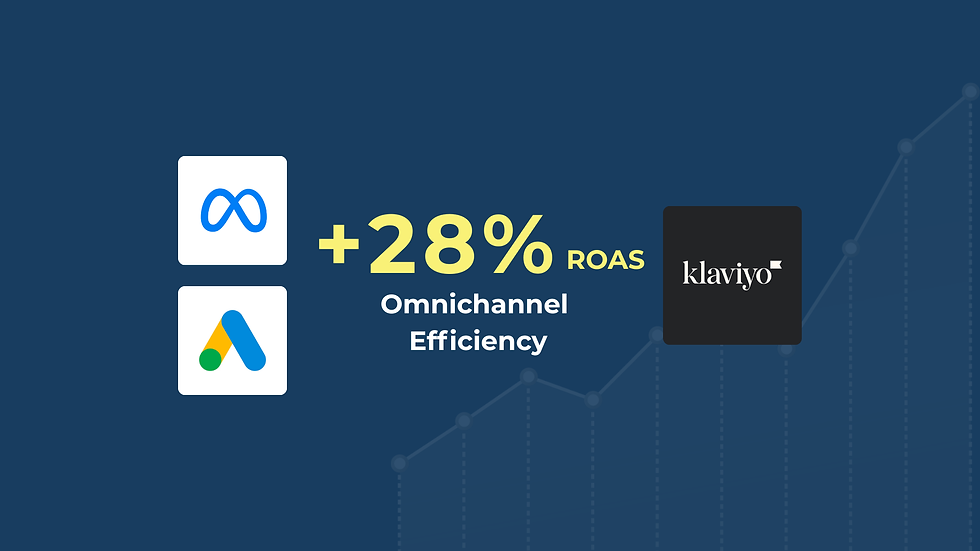
How to Leverage the Google Ads, Meta & Klaviyo Integration
Klaviyo is no longer just an email tool; it is a Customer Data Platform (CDP) that acts as the brain of your advertising. In this guide, we will walk you through how to build a strategic integration between Google Ads, Meta, and Klaviyo.
1. First-Party Data: A Future-Proof Strategy
The crumbling of third-party cookies has turned a company’s own data (First-Party Data) into its most critical currency. Through integration, you can transfer email addresses and phone numbers directly to advertising platforms as hashed data.
Why is this important? It is immune to browser changes. When a customer grants you marketing consent, you can reach them on Google and Meta with more precision than ever before, based on their actual purchase history.
2. Powering Advertising with Predictive Analytics: Leveraging Machine Learning
Klaviyo does more than just collect data; it applies advanced data science and machine learning to your account to generate actionable insights. This integration allows Google Ads to move beyond basic conversion tracking and leverage sophisticated predictions about future customer behavior.
The Strategy: Klaviyo calculates a Predicted CLV (an estimate of how much a customer will spend in the next 12 months) and a Churn Risk for each individual profile. By syncing these insights with Google Ads, you can build audiences based on a customer’s future potential rather than just their past actions. For instance, you can create a segment of "High-Value Future Customers"—profiles that Klaviyo's models identify as high-potential, even if they have only made a single purchase so far.
The Result: Google can identify and reach new "lookalike" audiences that mirror the characteristics of your most valuable (High-CLV) customers. Your advertising shifts from being reactive to proactive: your budget is automatically allocated toward profiles with the highest statistical probability of becoming loyal, high-value assets. This significantly improves the long-term efficiency and Return on Ad Spend (ROAS) of your campaigns.
3. Full-Funnel Retargeting: A Seamless Customer Journey
The customer journey is rarely linear. A strategic integration fills the gaps where email alone isn't enough.
Abandoned Carts: If a customer doesn’t open your abandoned cart email within 12 hours, you can automatically trigger a dynamic Meta ad featuring the exact product they left behind.
Audience Exclusions: This is the easiest way to save your budget. By syncing a "Recent Buyers" segment from Klaviyo to your Meta and Google lists, you can exclude them from sales conversion ads for 14 days. This allows you to reallocate that budget toward acquiring new customers or driving strategic cross-sales.
4. Lookalike Audiences 2.0
Forget generic "all visitors" audiences. Use your Klaviyo data to create high-intent Seed Lists of your best customers.
Pro Tip: Create a Meta Lookalike audience from a segment of customers who have made at least 3 purchases in the last year. This provides a significantly higher-quality signal for the algorithm than a simple website visit.
NOTE: For high-ticket products, requiring multiple purchases might not work, as the customer relationship may center around a single significant investment. In these cases, your Meta seed list should be built from a segment that demonstrates exceptional quality, such as a high initial order value or active, long-term brand engagement.
Senior Strategist’s Pro Tip: Dark Mode and Match Rate Optimization
For omnichannel marketing to be effective, data quality must be first-class.
Multi-Identifier Sync: Don't just sync email addresses. Klaviyo enables the synchronization of phone numbers as well. This can increase your Match Rate (the percentage of your list that the ad platform successfully identifies) by as much as 20–30%.
Accounting for Dark Mode in Ad Creatives: Emails are frequently read in Dark Mode. Ensure that your ad creatives on Google and Meta follow the same visual logic (e.g., using transparent backgrounds or colors optimized for dark themes). This ensures a consistent brand experience, regardless of the device or display settings your customer is using.
Summary: Toward an Autonomous Customer Experience
Integrating Google Ads, Meta, and Klaviyo is no longer a choice—it is a prerequisite for growth. This synergy enables the shift from static campaigns to autonomous experiences that adapt in real-time to customer behavior.
When data flows seamlessly, budgets are optimized and sales grow.
Sources:
Klaviyo (2026): Klaviyo and Google Strategic Partnership Announcement – Official release on AI-powered customer data utilization and integration.
LeadsBridge (2026): Meta Ads Best Practices for 2026 – A comprehensive guide to personalization and real-time audience synchronization.
Google Ads API (2026): Customer Match Policy and Best Practices – Technical requirements and standards for leveraging first-party data.
Klaviyo Help Center: Lookalike Audience Targeting & Social Audience Sync – Practical documentation for audience segmentation and cross-platform synchronization.